 EN
EN
 AR
AR
 BG
BG
 HR
HR
 CS
CS
 NL
NL
 FI
FI
 FR
FR
 DE
DE
 EL
EL
 IT
IT
 KO
KO
 NO
NO
 PL
PL
 PT
PT
 RO
RO
 RU
RU
 ES
ES
 SV
SV
 ID
ID
 LT
LT
 SR
SR
 UK
UK
 VI
VI
 HU
HU
 TH
TH
 TR
TR
 FA
FA
 MS
MS
 HY
HY
 AZ
AZ
 KA
KA
 BN
BN
 LO
LO
 LA
LA
 NE
NE
 MY
MY
 KK
KK
 KY
KY

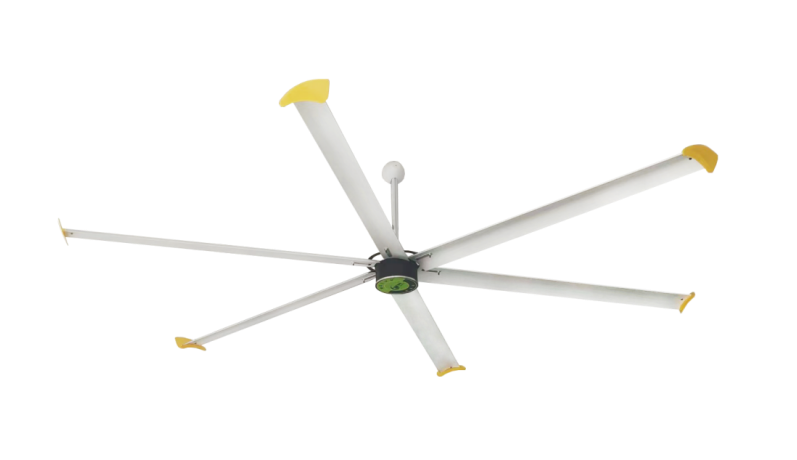
HVLS Fan Energy Efficiency: Core Physics and Operational Principles
High-Volume, Low-Speed Airflow Physics and Turbulence Reduction
High-Volume, Low-Speed (HVLS) fans achieve exceptional energy efficiency through aerodynamic design principles that move large air volumes at minimal rotational speeds. Unlike conventional high-speed fans—which generate disruptive vortices and uneven airflow—HVLS models use large-diameter blades (typically 7–24 feet) with precision-engineered airfoil profiles. This configuration produces a smooth, columnar downwash that spreads radially at floor level, delivering consistent, draft-free airflow across expansive areas. By minimizing turbulent mixing, these fans reduce kinetic energy loss and maximize coverage: a single unit often replaces 10–20 traditional fans. The underlying physics hinges on blade surface area and rotational velocity—larger blades displace more air per revolution, enabling efficient operation at just 40–100 RPM. As a result, HVLS fans consume only 0.75–1.5 kW per hour while circulating air across spaces exceeding 20,000 square feet—making them foundational to sustainable climate control in warehouses and industrial facilities.
Thermostat Offset Effect: How 2–4°F Perceived Cooling Reduces HVAC Runtime
HVLS fans enhance occupant comfort not by lowering ambient temperature, but by amplifying evaporative cooling on the skin—creating a wind-chill effect that delivers 2–4°F of perceived cooling. This physiological response allows facility managers to raise thermostat setpoints during cooling seasons without compromising comfort. For every 1°F increase in setpoint, HVAC runtime typically drops by 3–5%, reducing compressor cycling and electrical demand. ASHRAE Fundamentals (2023) confirms that a 3°F offset can cut cooling energy use by 10–15%. Crucially, HVLS fans maintain airspeeds below 3 mph—well within ASHRAE’s thermal comfort guidelines—ensuring benefits without drafts. When integrated with HVAC controls, this strategy enables stable 2–4°F setpoint increases during occupied hours. Given that air conditioning accounts for 40–60% of commercial energy use in warm climates, even modest runtime reductions yield outsized savings: field studies in manufacturing plants show 20–30% seasonal cooling energy reductions when HVLS fans are paired with optimized thermostat strategies.
Heat Destratification: Cutting HVAC Load in High-Ceiling Spaces
In facilities with ceilings over 20 feet, heat stratification is a major source of energy waste: warm air rises and pools near the roof while floor-level zones remain cool. This forces heating systems to overwork—raising energy consumption and degrading comfort. HVLS fans resolve this by gently mixing vertical air layers, eliminating thermal pockets and creating uniform temperature distribution from floor to ceiling.
Vertical Air Mixing in Spaces with 20+ ft Ceilings: Measured ΔT Reductions (ASHRAE RP-1672 Data)
ASHRAE RP-1672 research demonstrates that in unconditioned high-ceiling spaces, temperature differentials (ΔT) between floor and ceiling routinely exceed 10°F. With HVLS fans operating at low speed, that differential shrinks to under 2°F—effectively neutralizing stratification. The fans accomplish this using less than $1 per day in electricity, redistributing heat that would otherwise be lost through the roof. This mixing also stabilizes thermostat readings, preventing short-cycling and extending HVAC equipment life. The net result is a thermally balanced environment with 10–30% lower heating demand during cold months.
Real-World Impact: 27% Heating Energy Drop in a 240,000 sq ft Distribution Center
A Midwest distribution center—240,000 sq ft with 30-foot ceilings—faced chronic cold floors and high heating costs. After installing a coordinated array of HVLS fans, the facility achieved a 27% reduction in heating energy consumption. Fans operated continuously through winter, quietly destratifying without perceptible drafts. Natural gas usage fell by over 20,000 therms annually—delivering payback on the fan investment in under two years. This case validates destratification as a high-ROI strategy for large, high-ceiling industrial spaces.
Year-Round HVLS Fan Operation: Summer Cooling and Winter Heat Redistribution
HVLS fans deliver measurable energy savings across all seasons by adapting rotation direction and speed to thermal needs. In summer, forward rotation generates a gentle cooling breeze—supporting 3–5°F thermostat offsets and reducing both cooling runtime and peak electrical demand.
Reverse Mode for Radiant Heat Redistribution in Winter (NFPA 90A-Compliant Air Velocity Profiles)
During heating seasons, HVLS fans switch to reverse mode at low speed. This draws warm, stratified air from the ceiling and reintroduces it gently at occupant level—without violating NFPA 90A’s draft-limiting air velocity requirements. The process maintains comfort while flattening the vertical temperature gradient, cutting heating load by up to 20% without changing thermostat settings. This dual-season functionality makes HVLS fans a cornerstone of year-round energy optimization.
HVLS Fan and HVAC Synergy: Strategic Integration in Industrial Facilities
HVLS fans do not replace HVAC systems—they amplify them. In high-ceiling industrial facilities, they act as intelligent air distributors, working in concert with mechanical heating and cooling to eliminate stratification, suppress hotspots, and ensure even thermal delivery. Strategic placement—guided by facility layout, ceiling height, and HVAC ductwork—maximizes coverage while preserving laminar flow. When integrated with building management systems (BMS), HVLS fans respond dynamically to occupancy sensors and real-time temperature differentials, adjusting speed to match demand. This coordination reduces HVAC cycling frequency and mechanical stress, extending equipment lifespan. Critically, the synergy enables 2–4°F thermostat offsets in cooling mode and passive heat recovery in heating mode—transforming HVAC from a standalone system into a unified, responsive climate platform. The outcome is substantial energy reduction, improved occupant comfort, and measurable operational resilience.
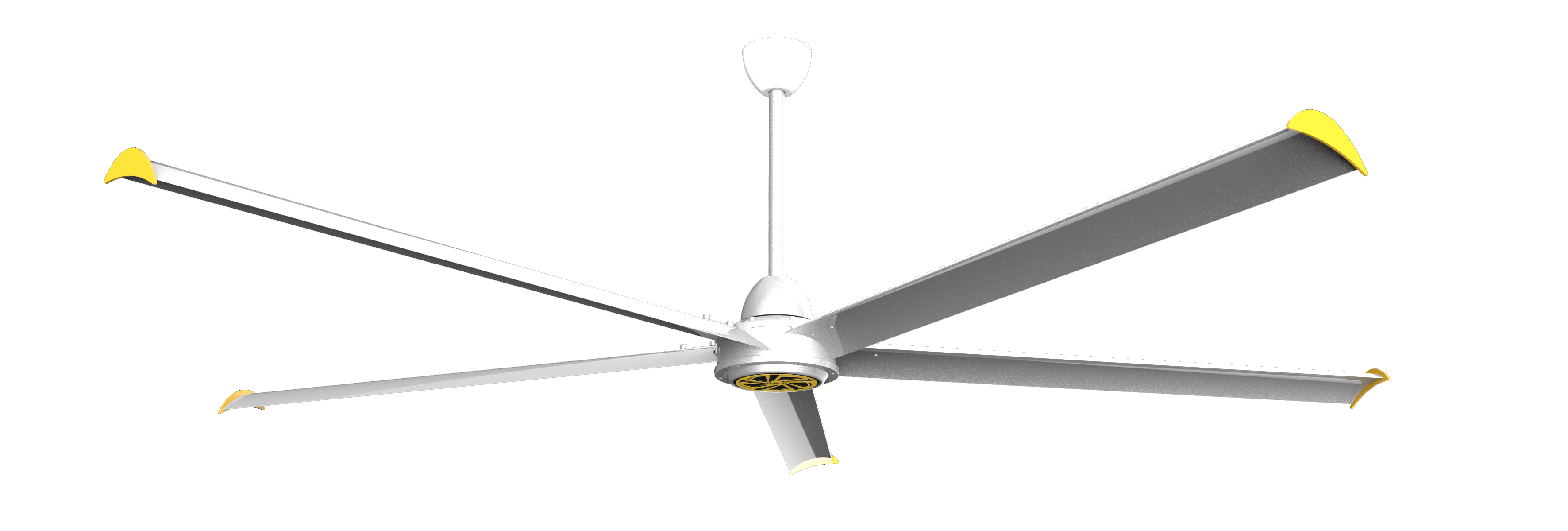
FAQs
What is an HVLS fan?
An HVLS fan is a High-Volume, Low-Speed ceiling fan with large blades that circulate air efficiently in large indoor spaces with minimal energy consumption.
How do HVLS fans save energy?
They move large volumes of air at low speeds to reduce stratification and aid HVAC systems, lowering heating and cooling demands significantly.
Can HVLS fans improve cooling in the summer?
Yes, HVLS fans enhance perceived cooling via evaporative effects, enabling thermostat setpoint increases by 2–4°F, reducing HVAC runtime and energy costs.
What benefits do HVLS fans offer in winter?
In winter, HVLS fans redistribute warm air trapped near the ceiling to the occupant level, lowering heating energy consumption.
Are HVLS fans compliant with building codes?
Yes, HVLS fans are designed to comply with standards such as NFPA 90A for safe airflow operation in both cooling and heating modes.
Table of Contents
-
HVLS Fan Energy Efficiency: Core Physics and Operational Principles
- High-Volume, Low-Speed Airflow Physics and Turbulence Reduction
- Thermostat Offset Effect: How 2–4°F Perceived Cooling Reduces HVAC Runtime
- Heat Destratification: Cutting HVAC Load in High-Ceiling Spaces
- Year-Round HVLS Fan Operation: Summer Cooling and Winter Heat Redistribution
- HVLS Fan and HVAC Synergy: Strategic Integration in Industrial Facilities
- FAQs
 ONLINE