 EN
EN
 AR
AR
 BG
BG
 HR
HR
 CS
CS
 NL
NL
 FI
FI
 FR
FR
 DE
DE
 EL
EL
 IT
IT
 KO
KO
 NO
NO
 PL
PL
 PT
PT
 RO
RO
 RU
RU
 ES
ES
 SV
SV
 ID
ID
 LT
LT
 SR
SR
 UK
UK
 VI
VI
 HU
HU
 TH
TH
 TR
TR
 FA
FA
 MS
MS
 HY
HY
 AZ
AZ
 KA
KA
 BN
BN
 LO
LO
 LA
LA
 NE
NE
 MY
MY
 KK
KK
 KY
KY

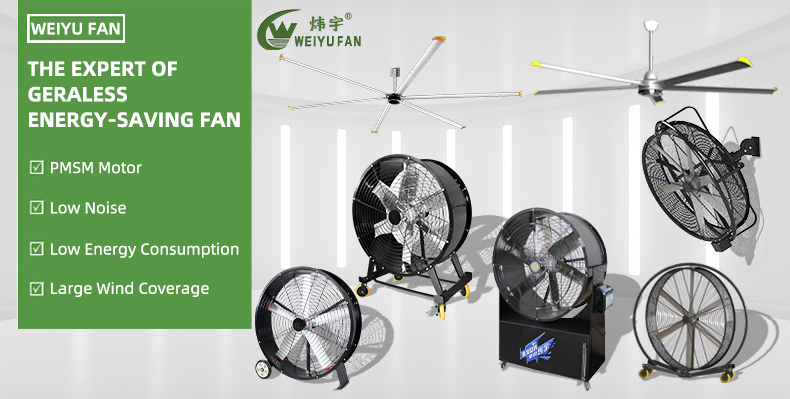
Big Fans Improve Air Distribution and Thermal Uniformity
The Problem: Air Stratification Reduces Efficiency in Barns and Greenhouses
In agricultural structures like barns and greenhouses, warm air naturally rises while cooler air settles near the ground—a phenomenon known as thermal stratification. This layering can create temperature differentials of up to 15°F between floor and rafters. As a result, heating systems overwork to warm occupied zones, wasting 20–30% of energy on unused overhead heat. Stagnant air further traps humidity and harmful gases like ammonia, undermining crop quality and livestock well-being.
How Big Fans Work: Laminar Airflow and Vertical Destratification up to 22 Feet
High Volume, Low Speed (HVLS) fans counteract stratification through engineered aerodynamics. Their large-diameter blades (8–24 feet) produce wide, slow-moving columns of laminar airflow that descend vertically—gently pushing warm ceiling air downward while drawing cooler air upward. This continuous, draft-free mixing eliminates thermal layers across spaces up to 22 feet high, maintaining thermal uniformity within ±2°F throughout the entire area.
Real-World Impact: 32% Reduction in Temperature Gradient in a Dairy Barn (UW–Madison, 2022)
A 2022 University of Wisconsin–Madison study in a commercial dairy barn demonstrated that HVLS fans reduced vertical temperature gradients by 32%. Floor-level temperatures stabilized at 68°F—even as rafters reached 86°F—improving feed intake by 9% and lowering respiratory illness rates. Critically, destratification cut winter heating costs by 27%, confirming that big fans deliver simultaneous gains in animal comfort and energy efficiency.
Big Fans Enhance Livestock Health and Welfare
Heat Stress Consequences: Lower Feed Conversion, Immunity, and Reproductive Performance
Heat stress disrupts core physiological processes in livestock. Elevated ambient temperatures force animals to redirect metabolic energy from growth and reproduction toward thermoregulation—reducing feed conversion efficiency by 15–30%. Chronic stress also elevates cortisol, suppressing immune response and increasing disease susceptibility. Reproductive performance declines markedly: dairy cows show 20–30% lower conception rates, while poultry experience diminished egg viability. These cascading effects erode both welfare standards and long-term productivity.
Physiological Benefits: Evaporative Cooling and Improved Air Quality (CO₂/Ammonia Dispersion)
Big fans enhance evaporative cooling via consistent, low-velocity airflow (2–5 mph) across animal surfaces—increasing sweat evaporation by up to 300% and lowering perceived temperature by 8–12°F. At the same time, their high-volume displacement (e.g., 50,000 CFM for a 24-foot unit) breaks up stagnant gas pockets, dispersing CO₂ and ammonia. This maintains airborne ammonia below the 10 ppm threshold critical for respiratory health and reduces pulmonary inflammation by 40%, according to peer-reviewed field measurements.
Validation: 18% Lower Mortality and 12% Higher Egg Production in HVLS-Equipped Layer Houses (USDA ARS, 2023)
Controlled USDA Agricultural Research Service trials in layer houses found HVLS systems reduced heat-related mortality by 18% and increased egg production by 12%, with measurable improvements in shell thickness. Dairy operations reported a 15% decline in mastitis incidence—linked to lower humidity and improved pathogen dispersion. These outcomes underscore how optimized airflow directly supports biological resilience and operational performance.
Big Fans Deliver Significant Energy and Operational Cost Savings
Energy Inefficiency of Conventional Ventilation: 3–5× Higher kWh per CFM vs. Big Fans
Conventional ventilation systems—relying on multiple small, high-speed fans—consume 3–5 times more energy per cubic foot per minute (CFM) than HVLS big fans. This inefficiency arises from turbulent airflow generation, which dissipates energy rapidly due to friction and pressure losses. In contrast, big fans use large-diameter blades to move air laminarly over distance, preserving momentum and minimizing wasted input—making them inherently better suited for the sustained, large-volume airflow needs of agricultural facilities.
Scalable Efficiency: One 24-Foot Big Fan Replaces 12–15 Small Fans with 70–80% Less Energy Use
A single 24-foot HVLS fan delivers equivalent coverage to 12–15 conventional units while using 70–80% less electricity. This consolidation yields compound savings:
- Energy reduction: Operating at under 2 RPM, big fans leverage the cubic relationship between blade diameter and airflow volume
- Infrastructure simplification: Fewer units mean less wiring, fewer control points, and dramatically lower maintenance and replacement costs
- HVAC synergy: By eliminating stratification, they enable thermostat adjustments of 3–6°F without sacrificing comfort—reducing HVAC runtime and energy demand
Most agricultural operations achieve full return on investment through electricity savings alone within 12–18 months.
FAQ
What is thermal stratification and why is it problematic?
Thermal stratification occurs when warm air rises and cooler air settles, creating temperature differentials within a space. This can lead to inefficient heating and energy wastage, as seen in agricultural structures like barns and greenhouses.
How do Big Fans help in preventing thermal stratification?
Big Fans, with their large-diameter blades, create a laminar airflow that destratifies air vertically, promoting an even temperature distribution and improving heating efficiency.
What benefits do Big Fans provide for livestock health?
Big Fans enhance livestock health by increasing evaporative cooling, lowering perceived temperatures, dispersing harmful gases like ammonia, and maintaining better air quality, ultimately improving animal comfort and productivity.
How do Big Fans contribute to energy savings?
Big Fans are more energy-efficient than conventional ventilation systems since they use large blades to generate a sustained airflow with less energy, potentially leading to 70–80% energy savings.
Can investment in Big Fans offer a quick return on investment?
Yes, most agricultural operations achieve a full return on investment through energy savings alone within 12–18 months after installing Big Fans.
 ONLINE