 EN
EN
 AR
AR
 BG
BG
 HR
HR
 CS
CS
 NL
NL
 FI
FI
 FR
FR
 DE
DE
 EL
EL
 IT
IT
 KO
KO
 NO
NO
 PL
PL
 PT
PT
 RO
RO
 RU
RU
 ES
ES
 SV
SV
 ID
ID
 LT
LT
 SR
SR
 UK
UK
 VI
VI
 HU
HU
 TH
TH
 TR
TR
 FA
FA
 MS
MS
 HY
HY
 AZ
AZ
 KA
KA
 BN
BN
 LO
LO
 LA
LA
 NE
NE
 MY
MY
 KK
KK
 KY
KY

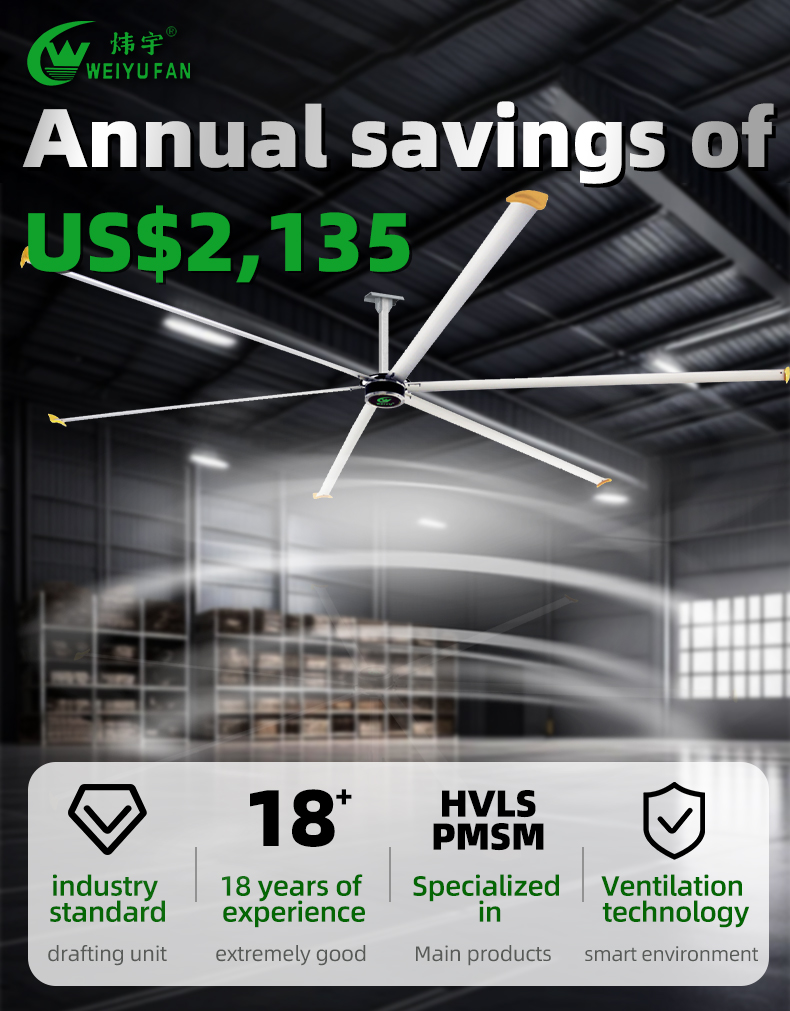
Why Industrial Ceiling Fans Deliver Superior Energy Efficiency
HVLS Aerodynamics: Moving Massive Air Volumes at 1–3 kW vs. HVAC’s 50–100 kW
High Volume, Low Speed (HVLS) ceiling fans leverage advanced aerodynamics to circulate large volumes of air using just 1–3 kW—dramatically less than traditional HVAC systems, which consume 50–100 kW for comparable coverage. Optimized blade geometry minimizes turbulence and maximizes laminar flow, enabling a single unit to effectively condition spaces exceeding 20,000 sq ft. This design delivers consistent, gentle airflow across entire facilities while using up to 98% less energy per square foot than conventional cooling methods.
De-stratification Effect: Reducing Heating Load by Up to 30% in Winter
In colder months, warm air naturally rises and accumulates near ceilings—a phenomenon known as heat stratification—leaving occupied zones uncomfortably cool. HVLS fans reverse this effect by gently mixing air vertically, redistributing trapped heat downward. This de-stratification creates uniform temperature distribution from floor to ceiling, allowing facilities to maintain comfort with thermostat settings 4–8°F lower. As confirmed by U.S. Department of Energy (DOE) benchmarks, the result is up to a 30% reduction in heating energy demand—while also mitigating moisture condensation and eliminating cold spots near loading docks or production lines.
Quantifiable Electricity Bill Savings Across Real Factory Operations
U.S. DOE Benchmark: 25–30% Reduction in Total Facility Energy Costs
The U.S. Department of Energy (DOE) reports that industrial facilities adopting HVLS ceiling fans achieve 25–30% reductions in total energy costs. These savings arise from two synergistic mechanisms: first, the fans’ inherent efficiency—moving vast air volumes at just 1–3 kW per unit—and second, their ability to reduce HVAC runtime year-round. In winter, de-stratification cuts heating loads; in summer, enhanced air movement improves perceived cooling, lowering reliance on mechanical cooling. The combined effect delivers dual-energy savings without compromising occupant comfort or indoor air quality.
Ohio Automotive Plant Case: 2.1 GWh Annual Reduction & 65% Less HVAC Runtime
An Ohio automotive assembly plant installed HVLS fans across its 500,000-sq-ft facility and achieved a verified 2.1 GWh annual electricity reduction—enough to power approximately 190 U.S. homes for one year. HVAC runtime dropped by 65%, and vertical temperature differentials shrank from 15°F to just 3°F floor-to-ceiling. With each fan drawing only 2.8 kW, the system delivered rapid payback while simultaneously reducing maintenance strain on HVAC equipment and improving thermal consistency across production zones.
Fast ROI: How Industrial Ceiling Fans Pay for Themselves in Under 18 Months
Industrial ceiling fans typically recover their full investment in under 18 months, driven primarily by energy savings and secondary operational benefits. Their ultra-efficient motors (1–3 kW) directly displace up to 30% of HVAC runtime—cutting electricity demand without sacrificing comfort. Beyond direct energy reduction, ROI accelerates through:
- Reduced product spoilage via stable humidity control
- Extended HVAC and process equipment lifespan due to reduced thermal cycling and condensation stress
- 3–8% gains in labor productivity linked to improved thermal comfort, as documented in peer-reviewed occupational ergonomics research
When these cumulative advantages are factored in, most manufacturing facilities achieve full cost recovery well within 18 months—converting what was once an overhead expense into a high-return operational asset.
Year-Round Value: Beyond Cooling — Ventilation, Humidity Control, and Worker Comfort
Industrial ceiling fans deliver holistic environmental management—not just seasonal cooling. By continuously displacing stagnant air, they enhance natural ventilation, diluting airborne contaminants such as welding fumes, solvents, and particulate matter—supporting compliance with OSHA air quality guidelines and reducing respiratory health risks. They also stabilize relative humidity: preventing mold growth in humid conditions and minimizing static discharge and condensation-related equipment damage in winter. Critically, this integrated climate control improves worker alertness and reduces fatigue-related errors by up to 12%, according to ergonomic studies cited by the National Institute for Occupational Safety and Health (NIOSH). As a result, HVLS fans function not as auxiliary tools, but as foundational components of safe, efficient, and human-centered industrial operations.
FAQ
What are HVLS fans?
High Volume, Low Speed (HVLS) fans are large industrial ceiling fans designed to circulate massive volumes of air at low rotational speeds, enhancing airflow efficiency.
How much energy can HVLS fans save compared to HVAC systems?
HVLS fans can reduce energy usage by up to 98% when compared to traditional HVAC systems. They improve air circulation at just 1-3 kW, compared to HVAC's 50-100 kW.
What is the typical return on investment for industrial ceiling fans?
Industrial ceiling fans generally achieve full cost recovery in under 18 months due to significant energy savings and operational benefits.
How do HVLS fans improve worker comfort and safety?
They enhance air quality and control humidity, reducing respiratory risks and fatigue in workers, while ensuring compliance with OSHA air quality standards.
 ONLINE