 EN
EN
 AR
AR
 BG
BG
 HR
HR
 CS
CS
 NL
NL
 FI
FI
 FR
FR
 DE
DE
 EL
EL
 IT
IT
 KO
KO
 NO
NO
 PL
PL
 PT
PT
 RO
RO
 RU
RU
 ES
ES
 SV
SV
 ID
ID
 LT
LT
 SR
SR
 UK
UK
 VI
VI
 HU
HU
 TH
TH
 TR
TR
 FA
FA
 MS
MS
 HY
HY
 AZ
AZ
 KA
KA
 BN
BN
 LO
LO
 LA
LA
 NE
NE
 MY
MY
 KK
KK
 KY
KY

Size Your Industrial Ceiling Fan for Space Dimensions and Airflow Coverage
Blade Diameter vs. Floor Area: Sizing Guidelines for Warehouses and Hangars
Selecting the correct blade diameter is foundational to airflow efficiency in large spaces. For areas under 1,000 m², 4–5 metre blades provide targeted coverage without excessive energy use. Facilities between 1,500–2,000 m² require 5.5–7 metre diameters to sustain consistent air movement, while expansive hangars exceeding 2,000 m² demand industrial HVLS fans with 7.3+ metre spans. Undersized units create airflow gaps—forcing HVAC systems to work up to 30% harder, per thermal efficiency studies (2024). Use this spacing matrix to ensure seamless coverage:
| Floor Area | Blade Diameter | Max. Coverage per Fan |
|---|---|---|
| < 1,000 m² | 4–5 m | 20 m radius |
| 1,500–2,000 m² | 5.5–7 m | 30 m radius |
| > 2,000 m² | 7.3 m+ | 40 m radius |
Ceiling Height Considerations and Optimal Mounting for Ceiling Fan Effectiveness
Mounting height directly affects airflow penetration into occupied zones. For ceilings under 6 metres, position fans 2.5–3 metres above floor level using standard mounts. In facilities with 8–12 metre clearances, extend downrods to lower fan height by 1 metre per additional 3 metres of ceiling elevation—this mitigates heat stratification. High-bay warehouses (>15 metres) benefit from angled mounts or tiered fan arrays to direct airflow downward effectively, reducing vertical temperature differentials by up to 5°C (ASHRAE Journal 2023). Maintain a minimum 2.5-metre clearance from obstructions to prevent turbulence and preserve laminar flow.
Strategic Spacing Layouts to Eliminate Airflow Gaps and Overlap
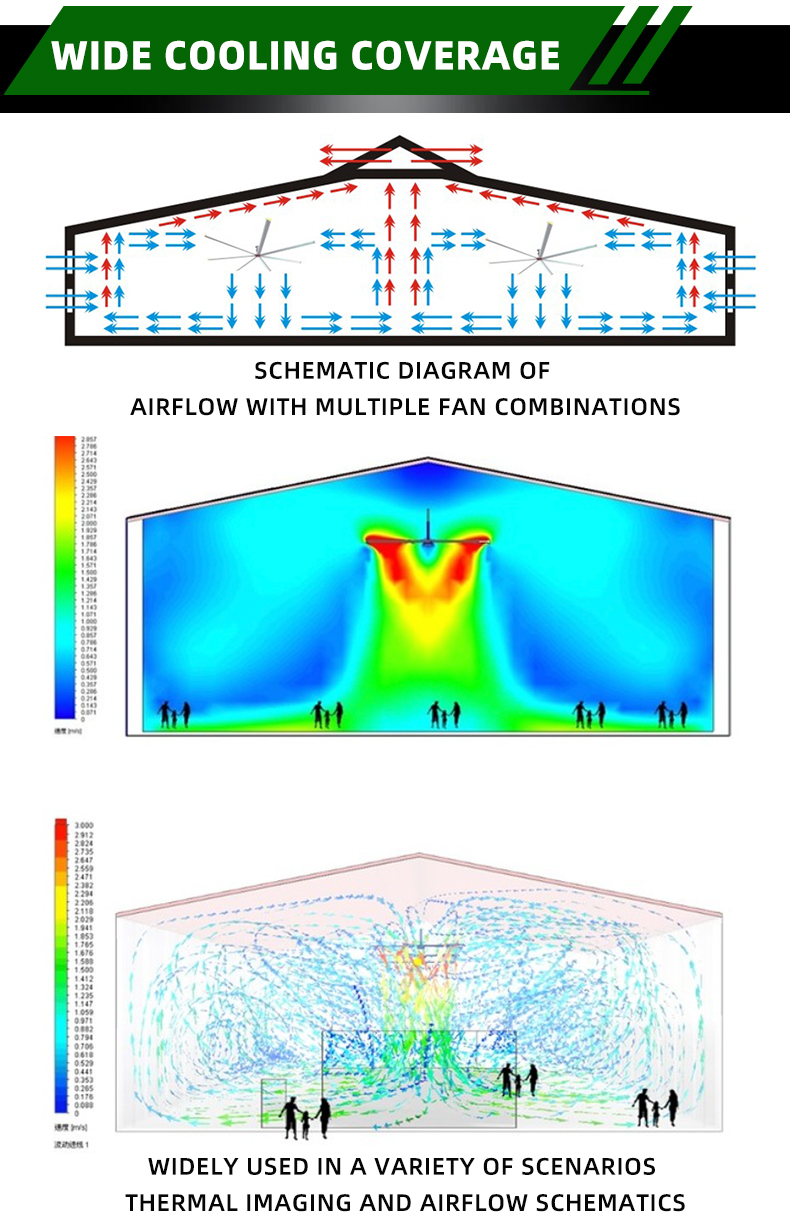
Eliminate dead zones through intentional placement: aim for 20–30% overlap between coverage circles. For 7-metre HVLS fans, space centres 10–12 metres apart in grid patterns—adjusting for fixed equipment or storage aisles. In rectangular spaces, align fans linearly parallel to workflow paths to enhance convective cooling where workers are active. Irregular footprints warrant computational fluid dynamics (CFD) modeling to identify placements that achieve uniform air velocity (±0.2 m/s variance), cutting compensatory HVAC usage and lowering annual energy costs by 18% (U.S. Department of Energy 2024).
Maximize Thermal Efficiency with Destratification-Focused Ceiling Fan Selection
How Heat Stratification Impacts Energy Use—and Why HVLS Ceiling Fans Reverse It
In large industrial spaces, heat rises and stratifies—creating temperature differences of 15–30°F between ceiling and floor levels (Industry Reports 2023). This layering forces HVAC systems to overcompensate, increasing runtime and energy waste. HVLS ceiling fans reverse stratification by gently pushing warm air downward via slow, high-volume rotation. Their low-RPM operation creates a stable vertical air column that mixes thermal layers without disruptive drafts—maintaining uniform temperatures and reducing HVAC demand. Unlike high-speed fans, HVLS models deliver efficient destratification with minimal power draw.
Proven HVAC Savings: 20–30% Reduction with Proper Industrial Ceiling Fan Destratification
Strategically deployed HVLS fans deliver measurable energy reductions. Facilities report 20–30% lower heating costs during winter months (Energy Efficiency Studies 2023). The mechanism is straightforward: redistributing trapped ceiling-level warmth reduces heating system load. In summer, enhanced air movement supports evaporative cooling on skin surfaces—improving perceived comfort without lowering thermostat settings. Key drivers include:
- Reduced HVAC cycling, as stable temperatures prevent system overcompensation
- Thermostat adjustments of up to 4°F, enabled by even heat distribution
-
Improved condensation control, as continuous circulation minimizes moisture buildup that strains dehumidifiers
Savings depend critically on proper sizing and placement—underpowered units leave gaps; oversized fans risk occupant discomfort. Smart controls further optimize performance by modulating speed in response to real-time temperature gradients.
Assess Motor Technology, Controls, and Electrical Integration for Long-Term Reliability
Direct-Drive, EC, and Permanent Magnet Motors: Efficiency, Lifespan, and Ceiling Fan Torque Compared
Motor selection defines long-term reliability and operational economics. Electronically Commutated (EC) motors lead in energy efficiency—often exceeding IE5 standards—and significantly reduce electricity costs in large facilities. Permanent magnet motors deliver high torque at low RPMs, making them ideal for heavy-duty blades in demanding warehouse environments. Direct-drive systems eliminate belts and gears, cutting maintenance requirements by up to 30% over time. While EC motors offer peak efficiency, permanent magnet variants excel in durability under continuous operation. Prioritise motors with industrial-grade sealed bearings and integrated thermal protection to withstand dust, vibration, and elevated ambient temperatures.
VFD Compatibility and Smart Speed Control for Adaptive Load Management
Variable Frequency Drives (VFDs) transform static fans into responsive components of an integrated building system. VFD-compatible fans enable:
- Dynamic airflow modulation synced to HVAC cycles
- 20–40% energy savings through intelligent speed ramping
- Reduced mechanical stress during startup and shutdown
Smart controls support zone-based operation—increasing airflow in high-traffic areas while scaling back in unoccupied zones. This adaptive load management extends motor life, improves thermal comfort across seasons, and aligns air movement precisely with occupancy and process needs.
| Motor Feature | Energy Impact | Operational Benefit |
|---|---|---|
| VFD Compatibility | 20–40% HVAC synergy | Prevents overcooling/heating |
| Sealed Bearings | 15% longer service life | Dust resistance in warehouses |
| Thermal Protection | 30% fewer failures | Handles high ambient temperatures |
Match Industrial Ceiling Fan Specifications to Critical Industry Requirements
Industrial environments demand purpose-built ceiling fan solutions aligned with sector-specific risks and regulatory obligations. Food processing facilities require stainless steel construction and IP-rated sealed motors to survive daily washdowns and inhibit bacterial growth—essential for compliance with FDA and HACCP hygiene standards. Warehouses prioritise high-volume, low-speed airflow systems that eliminate thermal stratification across vast floorplates, supporting HVAC runtime reductions of 20–30% (ASHRAE Journal 2024). Chemical plants and other hazardous locations mandate explosion-proof motors with non-ferrous components to eliminate ignition risks in volatile atmospheres. By matching specifications—including corrosion resistance, airflow profile, ingress protection, and safety certifications—to industry-specific hazards and operational workflows, facilities ensure regulatory compliance while achieving meaningful gains in energy efficiency, worker comfort, and equipment longevity.
FAQ Section
How do I choose the right blade diameter for my space?
Blade diameter depends on the size of the floor area. For areas under 1,000 m², 4–5 metre blades are sufficient. Larger areas between 1,500–2,000 m² need 5.5–7 metre blades, while spaces over 2,000 m² require spans of 7.3 metres or more.
What is the recommended mounting height for industrial ceiling fans?
For ceilings below 6 metres, fans should be mounted 2.5–3 metres above the floor. For spaces with higher ceilings, downrods or angled mounts may be required to lower fans appropriately.
How can HVLS ceiling fans improve HVAC efficiency?
HVLS fans redistribute trapped ceiling-level warmth in winter and enhance air movement for cooling in summer, leading to 20–30% HVAC energy savings.
What type of motor technology should I look for in industrial ceiling fans?
Electronically Commutated (EC) motors are ideal for efficiency, while permanent magnet motors excel in durability. Direct-drive systems minimize maintenance issues.
Are HVLS fans suitable for food processing facilities?
Yes, provided they feature stainless steel construction and IP-rated sealed motors to withstand washdowns and comply with hygiene standards.
 ONLINE