 EN
EN
 AR
AR
 BG
BG
 HR
HR
 CS
CS
 NL
NL
 FI
FI
 FR
FR
 DE
DE
 EL
EL
 IT
IT
 KO
KO
 NO
NO
 PL
PL
 PT
PT
 RO
RO
 RU
RU
 ES
ES
 SV
SV
 ID
ID
 LT
LT
 SR
SR
 UK
UK
 VI
VI
 HU
HU
 TH
TH
 TR
TR
 FA
FA
 MS
MS
 HY
HY
 AZ
AZ
 KA
KA
 BN
BN
 LO
LO
 LA
LA
 NE
NE
 MY
MY
 KK
KK
 KY
KY

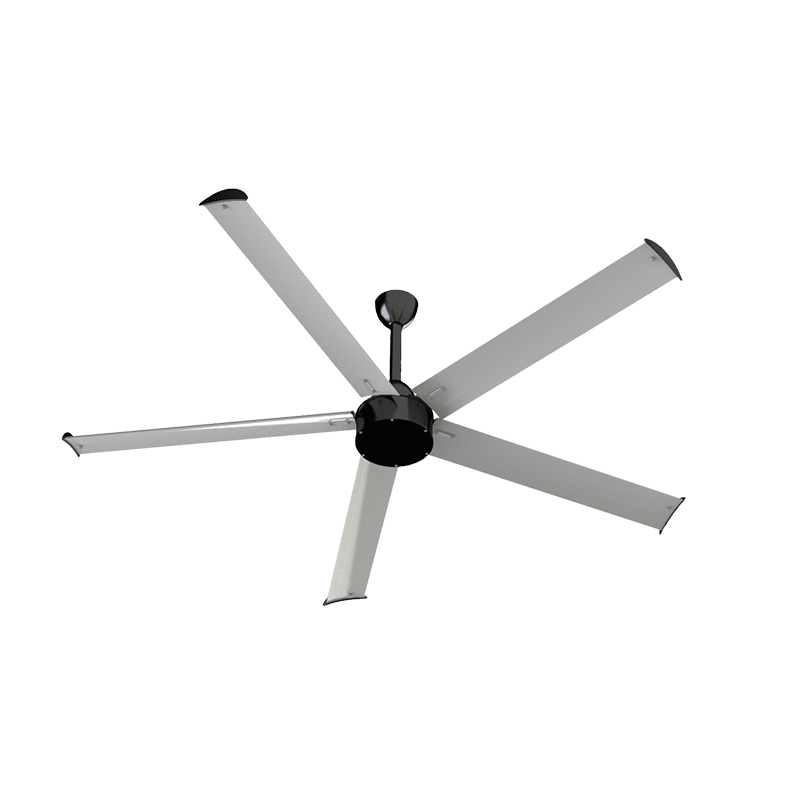
How Pole Fans Generate Effective Vertical Airflow in High-Ceiling Workshops
The Physics of Vertical Air Movement: Disrupting Thermal Stratification
In high-ceiling workshops, thermal stratification creates distinct temperature layers—warm air accumulates near the ceiling while cooler air settles at floor level. Pole fans counteract this by drawing warm air from the upper zone and propelling it downward in a controlled column. This vertical movement forces stratified layers to mix, equalizing temperatures across the space. Engineered blade pitch and rotational speed maximize airflow volume while minimizing energy use. By continuously redistributing heated ceiling air downward, pole fans reduce heating loads in winter and deliver cooling airflow in summer. They also suppress moisture buildup on surfaces, protecting equipment from condensation damage. Consistent vertical circulation eliminates stagnant air pockets, supporting both occupant comfort and operational productivity—a simple, efficient solution for large-volume spaces.
Bernoulli-Driven Laminar Flow and Boundary Layer Control
Pole fan efficiency relies on aerodynamic principles—including Bernoulli’s equation and boundary layer control. As blades rotate, pressure differentials between upper and lower surfaces accelerate air, generating a laminar flow that expands into a broad, uniform column. This low-turbulence pattern preserves energy and enables airflow to reach distant floor areas without significant dissipation. Precise blade shaping maintains an attached boundary layer, preventing flow separation and preserving thrust. Optimized curvature and angle of attack yield a high lift-to-drag ratio, moving more air per watt. The result is a steady, directed vertical draft that breaks up thermal pockets and distributes conditioned air evenly—enabling quiet, reliable operation over extended periods.
Strategic Pole Fan Placement to Eliminate Dead Zones and Heat Pockets
Improper placement wastes energy and fails to resolve uneven temperatures. Strategic deployment begins with zone-based airflow mapping—using thermal imaging and Computational Fluid Dynamics (CFD) modeling to visualize heat distribution. Thermal scans identify surface temperature variations across walls, floors, and equipment, revealing where heat accumulates. CFD simulations then predict how pole fan airflow will interact with existing ventilation, machinery, and structural obstructions. This data-driven approach allows precise fan positioning to disrupt thermal buildup before it spreads—avoiding ineffective locations such as behind tall racking or adjacent to columns.
Triangulated Pole Fan Arrays for Targeted Vortex Disruption Near Equipment
Once hot zones are identified, triangulated pole fan arrays focus airflow directly on trouble spots. Arranging three or more fans in a triangular pattern around heat-generating machinery creates overlapping air streams that break down stagnant vortexes. This targeted disruption prevents localized heat pockets near critical equipment—enhancing worker comfort and safeguarding temperature-sensitive processes. Positioning these arrays within active work zones ensures consistent, uniform air exchange throughout the facility.
Key Installation Factors That Maximize Pole Fan Performance
Optimal Mounting Height, Tilt Angle, and Clearance for Uniform Air Distribution
To achieve uniform airflow, mounting height must align with ceiling height—typically 10–15 feet above the floor. A fan mounted too low creates uncomfortable concentrated drafts; one mounted too high weakens the air column’s impact. A downward tilt of 15°–25° directs airflow toward the occupied zone rather than the ceiling. Equally important is clearance: maintain at least 3–5 feet of unobstructed space around the fan on all sides. Walls, columns, or nearby equipment disrupt inflow and induce turbulence, reducing efficiency. Proper clearance ensures the fan draws in undisturbed air and delivers it evenly across the floor. Adjustable brackets and angle-locking mechanisms on quality pole fans simplify fine-tuning for specific bay layouts.
Fixed vs. Telescopic Pole Fans: Matching Design to Variable Workshop Heights
Workshops with uniform ceiling heights benefit from fixed-length pole fans—offering simplicity, rigidity, and fewer failure points due to reduced moving parts. In contrast, telescopic pole fans excel in facilities with varying roof elevations, such as warehouses with mezzanines or loading docks. Their adjustable column enables precise height calibration per zone without hardware replacement—eliminating the need for multiple fan types and simplifying reconfiguration during layout changes. When selecting, consider not only current clearance requirements but also future expansion plans: telescopic designs provide a single, adaptable solution for evolving floor plans.
Pole Fans vs. HVLS Fans: Choosing the Right Air Circulation Solution for Your Workshop
Choosing between pole fans and HVLS (High-Volume, Low-Speed) fans depends on ceiling height, spatial layout, and airflow objectives. Pole fans mount on adjustable vertical poles—ideal for variable ceiling heights or environments with obstructions like tall racking. HVLS fans, by contrast, are large-diameter ceiling-mounted units best suited for open, contiguous spaces with consistent ceiling clearance. Pole fans deliver concentrated, directional airflow to specific zones—such as workbenches or machinery—while HVLS fans generate broad, gentle circulation ideal for whole-space thermal management. The table below highlights key distinctions:
| Factor | Pole Fan | HVLS Fan |
|---|---|---|
| Mounting | Pole-mounted, adjustable height | Ceiling-mounted, fixed height |
| Airflow pattern | Targeted, directional column | Broad, diffuse air movement |
| Best for | Multi-level workshops, spot cooling, equipment zones | Open warehouses, uniform temperature control |
| Height flexibility | High (telescopic pole allows 10–30 ft range) | Low (requires uniform ceiling height) |
| Installation cost | Lower (no structural ceiling support needed) | Higher (requires ceiling reinforcement) |
| Energy consumption per fan | Varies by motor size, typically 0.5–1.5 kW | 0.8–2.5 kW for fans 8–24 ft diameter |
For workshops with tall racks, partitioned areas, or inconsistent ceiling heights, a single pole fan can be strategically placed to eliminate dead zones and heat pockets without affecting the entire building. HVLS fans—though highly effective in large open volumes—may produce uneven coverage or turbulence in compartmentalized layouts. Choose a pole fan when you need adaptable, targeted air movement; select an HVLS fan when your workshop is a single, open volume with high, uniform ceilings.
FAQs
What is thermal stratification, and how do pole fans address it?
Thermal stratification refers to the layering of warm air at the ceiling and cool air at the floor. Pole fans disrupt these layers by directing warm air downwards, equalizing temperatures.
How are pole fans different from HVLS fans?
Pole fans provide targeted, directional airflow and are suitable for multi-level layouts and areas with obstructions. HVLS fans, on the other hand, provide broad, gentle circulation in open, high-ceiling spaces.
What factors should be considered when installing pole fans?
Proper mounting height, tilt angle, and sufficient clearance are essential to ensure uniform airflow and prevent turbulence caused by obstructions.
How do telescopic pole fans benefit workshops with varying ceiling heights?
Telescopic pole fans offer adjustable heights, allowing precise positioning for optimal airflow in areas with inconsistent roof elevations.
Can pole fans reduce energy costs?
Yes, by redistributing air efficiently, pole fans minimize the need for heating and cooling systems to work excessively, reducing energy consumption.
 ONLINE