 EN
EN
 AR
AR
 BG
BG
 HR
HR
 CS
CS
 NL
NL
 FI
FI
 FR
FR
 DE
DE
 EL
EL
 IT
IT
 KO
KO
 NO
NO
 PL
PL
 PT
PT
 RO
RO
 RU
RU
 ES
ES
 SV
SV
 ID
ID
 LT
LT
 SR
SR
 UK
UK
 VI
VI
 HU
HU
 TH
TH
 TR
TR
 FA
FA
 MS
MS
 HY
HY
 AZ
AZ
 KA
KA
 BN
BN
 LO
LO
 LA
LA
 NE
NE
 MY
MY
 KK
KK
 KY
KY

Understanding Thermal Stratification and Why HVLS Fans Are the Optimal Solution
The Science of Heat Rise and Air Layering in High-Ceiling Workshops
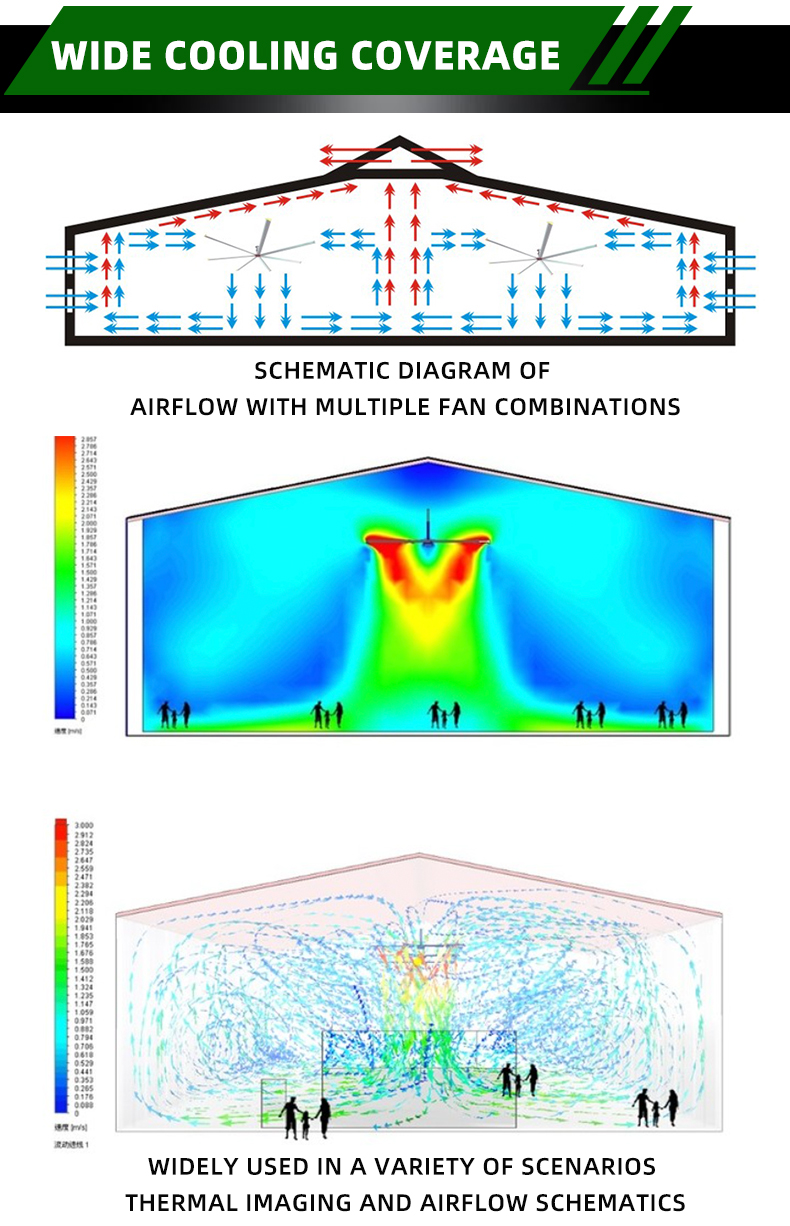
In industrial workshops with elevated ceilings, thermal stratification occurs as warm air rises due to convection—forming distinct temperature layers. At ceiling level, air can be 20–30°F hotter than at floor level, creating an inefficient vertical gradient. HVAC systems then overwork to heat occupied zones, while workers remain cold below. High Volume Low Speed (HVLS) fans resolve this by generating a broad, gentle column of downward-moving air (typically ≤5 mph). This airflow safely mixes strata without drafts, reducing vertical temperature differentials to ≤4°F—even in spaces exceeding 40 ft in height.
Why Traditional HVAC and Small Fans Fail to Destratify Effectively
Standard HVAC systems regulate temperature but lack the air movement needed to disrupt stratification—and forced-air units often worsen it by discharging heated air toward the ceiling. Small high-speed fans are similarly ineffective: their turbulent, localized airflow causes draft discomfort, moves insufficient volume (≤10,000 CFM) to reach high ceilings, and operate inefficiently at ≥1,000 RPM. Facility energy audits consistently show that these approaches leave 50–70% of heating energy stranded overhead—making them poor destratification tools.
HVLS Fan Design and Operation for Reliable Destratification
Blade Geometry, RPM Control, and Low-Speed High-Volume Air Movement
HVLS fan blades—up to 24 feet in diameter—use engineered airfoil profiles to maximize displacement at ultra-low RPMs. This design enables quiet, energy-efficient movement of massive air volumes downward (3–8 mph), gently blending warm ceiling air with cooler floor-level zones. Unlike small fans that merely stir localized air, HVLS units create continuous, laminar vertical circulation—breaking thermal layers without discomfort. A single 24-foot unit consumes as little as 100 watts per hour during winter destratification, outperforming clusters of conventional fans on both airflow coverage and energy use.
Forward vs. Reverse Mode: Seasonal Application Best Practices for HVLS Fans
HVLS fans deliver year-round value through mode-specific operation. In reverse mode (winter), they draw rising warm air down to occupant level—enabling thermostat setbacks of 4–7°F while maintaining comfort and cutting heating costs by up to 30%. In forward mode (summer), they accelerate evaporative cooling, lowering perceived temperature by 8–10°F and reducing reliance on mechanical cooling. When paired with ambient sensors or programmable timers, seasonal switching optimizes destratification and minimizes HVAC runtime across all seasons.
Strategic HVLS Fan Deployment: Sizing, Spacing, and Workshop Layout Integration
Matching HVLS Fan Diameter and Quantity to Ceiling Height and Bay Dimensions
Optimal destratification depends on aligning fan specifications with physical space constraints. Ceiling height determines minimum blade diameter: workshops under 6 meters (20 ft) suit 7.3-meter (24-ft) fans, while facilities with 24-meter (80-ft) ceilings require correspondingly large units to move sufficient air mass. Spacing follows bay geometry—a single 20-meter fan covers a ~17-meter square area, but elongated bays need multiple units spaced 1.5× fan diameter apart. Positioning fans perpendicular to material handling paths further enhances cross-workstation airflow. Thermal mapping studies confirm that aligning fan count with heat-source density—such as near ovens or welding stations—improves thermal uniformity by 23% and reduces HVAC runtime by 19% annually.
Measurable Outcomes: Energy Savings, HVAC Efficiency, and Human Comfort Gains
Field-Validated Results: 20–30% HVAC Runtime Reduction and Payback in Under 2 Years
Real-world deployments consistently demonstrate that HVLS fans reduce HVAC runtime by 20–30%—primarily by recycling trapped ceiling heat downward instead of allowing it to accumulate unused. During heating seasons, this translates directly into lower fuel or electricity consumption. In cooling seasons, enhanced air movement elevates perceived comfort by 3–5°F, decreasing AC demand. Combined, these effects yield a typical payback period of under two years through energy savings alone. Additional benefits include fewer worker complaints about temperature inconsistency and extended HVAC equipment life due to reduced operational strain—reinforcing HVLS technology as a high-impact, EEAT-aligned solution for large-volume industrial environments.
FAQ
What is thermal stratification in industrial environments?
Thermal stratification in industrial environments refers to the layering of air with varying temperatures, where warmer air rises towards the ceiling, leaving cooler air below. This often results in energy inefficiency and discomfort for workers.
How do HVLS fans combat thermal stratification?
HVLS fans create a gentle downward air column that mixes the warm air at the ceiling with cooler air at floor level, effectively reducing temperature differentials and improving comfort without causing drafts.
Why are traditional HVAC systems and small fans ineffective against stratification?
Traditional HVAC systems often exacerbate stratification by pushing warm air towards the ceiling, while small fans produce localized airflow that isn’t capable of effectively mixing air in large, high-ceiling spaces.
How does the deployment of HVLS fans influence energy consumption?
By efficiently recycling ceiling heat and enhancing cooling in the summer, HVLS fans reduce the workload on HVAC systems, leading to significant energy savings and a reduction in operational costs.
Table of Contents
- Understanding Thermal Stratification and Why HVLS Fans Are the Optimal Solution
- HVLS Fan Design and Operation for Reliable Destratification
- Strategic HVLS Fan Deployment: Sizing, Spacing, and Workshop Layout Integration
- Measurable Outcomes: Energy Savings, HVAC Efficiency, and Human Comfort Gains
- FAQ
 ONLINE