 EN
EN
 AR
AR
 BG
BG
 HR
HR
 CS
CS
 NL
NL
 FI
FI
 FR
FR
 DE
DE
 EL
EL
 IT
IT
 KO
KO
 NO
NO
 PL
PL
 PT
PT
 RO
RO
 RU
RU
 ES
ES
 SV
SV
 ID
ID
 LT
LT
 SR
SR
 UK
UK
 VI
VI
 HU
HU
 TH
TH
 TR
TR
 FA
FA
 MS
MS
 HY
HY
 AZ
AZ
 KA
KA
 BN
BN
 LO
LO
 LA
LA
 NE
NE
 MY
MY
 KK
KK
 KY
KY

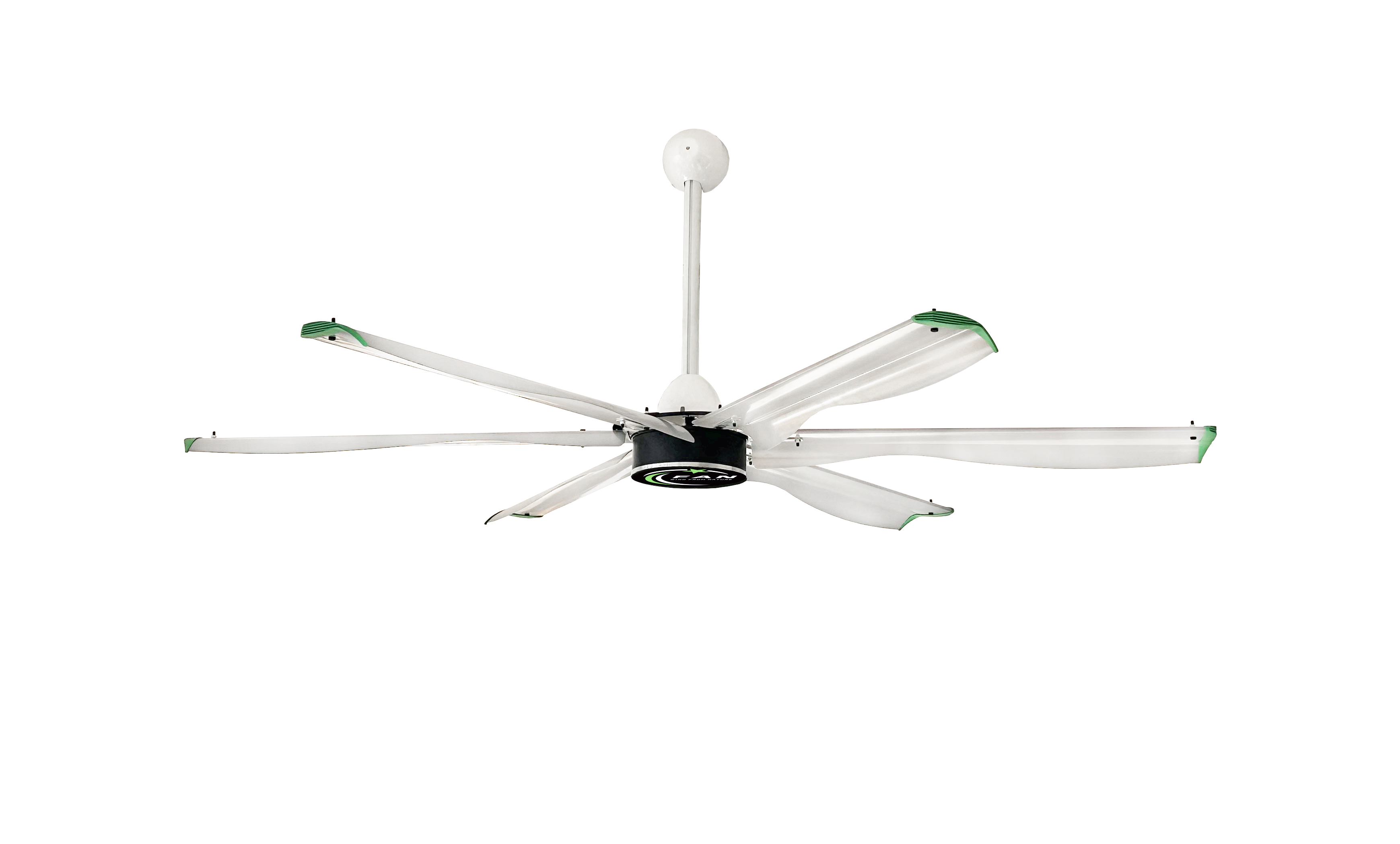
How Industrial Ceiling Fans for Warehouse Ventilation Cut Energy Use
Air Movement Physics: Reducing HVAC Load Through Gentle, High-Volume Displacement
Industrial HVLS (high-volume, low-speed) fans generate a broad, gentle column of air that moves downward and spreads across the floor. This displacement triggers evaporative cooling on the skin—making occupants feel 5–10°F cooler without lowering the thermostat. In winter, the same downward flow pushes trapped warm air from the ceiling back into the occupied zone, eliminating the need to reheat stagnant air. Because each fan consumes only 1–3 kW—comparable to a small appliance—while moving tens of thousands of cubic feet per minute, its air-movement-to-power ratio far exceeds that of traditional HVAC blowers. By supplementing or partially replacing mechanical heating and cooling cycles, an industrial ceiling fan for warehouse ventilation can significantly reduce compressor and furnace runtime. The result is measurable kilowatt-hour savings—without compromising worker comfort or productivity.
Validated Savings: 20–50% Cooling Cost Reduction (ASHRAE & DOE Benchmarks)
Field studies cited by ASHRAE and the U.S. Department of Energy show large-ceiling warehouses consistently achieve 20% to 50% cooling cost reductions after installing HVLS fans. During summer, elevated air speed allows thermostat setpoints to rise by 4–7°F while maintaining equivalent thermal comfort. Since air-conditioning energy use drops roughly 3–5% per degree Fahrenheit increase, these adjustments yield substantial cumulative savings. In winter, destratification reduces heating costs by up to 30% by reclaiming heat that would otherwise remain stranded near the roof. These benchmarks hold across diverse climate zones and facility types—from dry-storage distribution centers to humid manufacturing floors—and often deliver payback in under two years.
Destratification and Uniform Climate Control in High-Ceiling Warehouses
Solving Thermal Stratification: Eliminating 10°F–30°F Vertical Temperature Gradients
In high-ceiling warehouses, buoyant warm air rises while denser cool air settles—creating vertical temperature gradients of 10°F to 30°F. Workers at floor level may experience 65°F while roof-level sensors read 85°F or higher. This stratification forces HVAC systems to over-cycle, wasting energy. Industrial ceiling fans for warehouse ventilation break up these layers by gently pushing warm air downward and mixing it with cooler air near the floor. The result is a near-uniform temperature profile from floor to roof. Field data confirm destratification can cut annual HVAC energy use by 10–30%. Employees no longer shiver at ground level or overheat near mezzanines, improving both comfort and productivity. Consistent air mixing also minimizes condensation on metal racking and stored goods—helping preserve inventory quality.
Slow-Revolution Mechanics: Why HVLS Fans Achieve Uniformity Without Turbulence
HVLS fans rotate at just 30–60 rpm yet move massive volumes of air. Their slow speed avoids disruptive drafts while covering diameters up to 24 feet. Aerodynamically shaped blades push air downward along their full length; when the column hits the floor, it spreads outward and rises along walls—forming a quiet, continuous circulation loop. Unlike high-speed fans, HVLS units operate with minimal noise and turbulence, ensuring stable airflow that doesn’t disturb workers or lightweight materials. This non-turbulent pattern eliminates cold spots near loading docks and warm pockets under skylights—delivering consistent thermal conditions throughout the space with exceptional energy efficiency.
Smart Integration of Industrial Ceiling Fans with Existing HVAC Systems
Complementing warehouse HVAC systems with industrial ceiling fans unlocks unprecedented energy efficiency. Designed to synergize with existing climate control infrastructure, HVLS fans reduce mechanical heating and cooling demands through optimized air circulation—without requiring system overhauls or downtime.
Setpoint Elevation Strategy: Raising Thermostat Settings 4–7°F Safely Using Fan-Assisted Distribution
HVLS fans improve perceived thermal comfort by 5–8°F (per ASHRAE Standard 55), enabling safe thermostat adjustments during cooling seasons. Gentle airflow enhances skin evaporation rates, making ambient conditions feel cooler than measured temperatures. A validated strategy combines:
- Summer thermostat increases of 4–7°F
- Reduced HVAC runtime via superior air mixing
- Improved compressor efficiency by minimizing microcycling
Conservative estimates place resulting cooling energy savings at 25%, as fans displace intensive mechanical conditioning during peak demand periods.
Proven ROI: Operational Cost Savings and Rapid Payback
Under-2-Year Payback: Case Evidence from a 320,000 sq ft Distribution Center
Return on investment remains the top priority for warehouse managers and financial decision-makers—and HVLS fans deliver compelling evidence. Consider a real-world example: a 320,000-square-foot distribution center that installed 24 HVLS fans as part of its ventilation strategy. The outcome? Annual energy expenditures dropped by 35%, delivering full payback in just 18 months—well under the conventional two-year benchmark. The project achieved a 45% internal rate of return (IRR), outperforming most HVAC upgrades. Additional bottom-line benefits—including improved employee productivity and reduced product damage from condensation and temperature swings—further strengthened the financial case. With minimal maintenance requirements, these savings continue reliably for over a decade.
FAQ
What is an HVLS fan, and how does it work?
HVLS stands for high-volume, low-speed. These fans operate at lower speeds to move large air volumes gently, creating uniform airflow across large spaces like warehouses.
How do HVLS fans save energy in warehouses?
HVLS fans decrease HVAC runtime by improving air circulation and mixing. During cooling seasons, they make occupants feel cooler without lowering the thermostat. In heating seasons, they redistribute warm air trapped near the ceiling.
What are the cost-saving benchmarks of HVLS fans?
According to ASHRAE and DOE studies, HVLS fans can cut cooling costs by 20–50% and heating costs by up to 30%. These savings often lead to a payback period of under two years.
Will HVLS fans disturb workers or lightweight materials in the warehouse?
No, HVLS fans run at slow speeds (30–60 rpm) and create non-turbulent airflow, ensuring minimal noise and disruption.
Do HVLS fans require modifications to existing HVAC systems?
No, they are designed to complement existing systems without requiring overhauls or downtime.
 ONLINE