 EN
EN
 AR
AR
 BG
BG
 HR
HR
 CS
CS
 NL
NL
 FI
FI
 FR
FR
 DE
DE
 EL
EL
 IT
IT
 KO
KO
 NO
NO
 PL
PL
 PT
PT
 RO
RO
 RU
RU
 ES
ES
 SV
SV
 ID
ID
 LT
LT
 SR
SR
 UK
UK
 VI
VI
 HU
HU
 TH
TH
 TR
TR
 FA
FA
 MS
MS
 HY
HY
 AZ
AZ
 KA
KA
 BN
BN
 LO
LO
 LA
LA
 NE
NE
 MY
MY
 KK
KK
 KY
KY

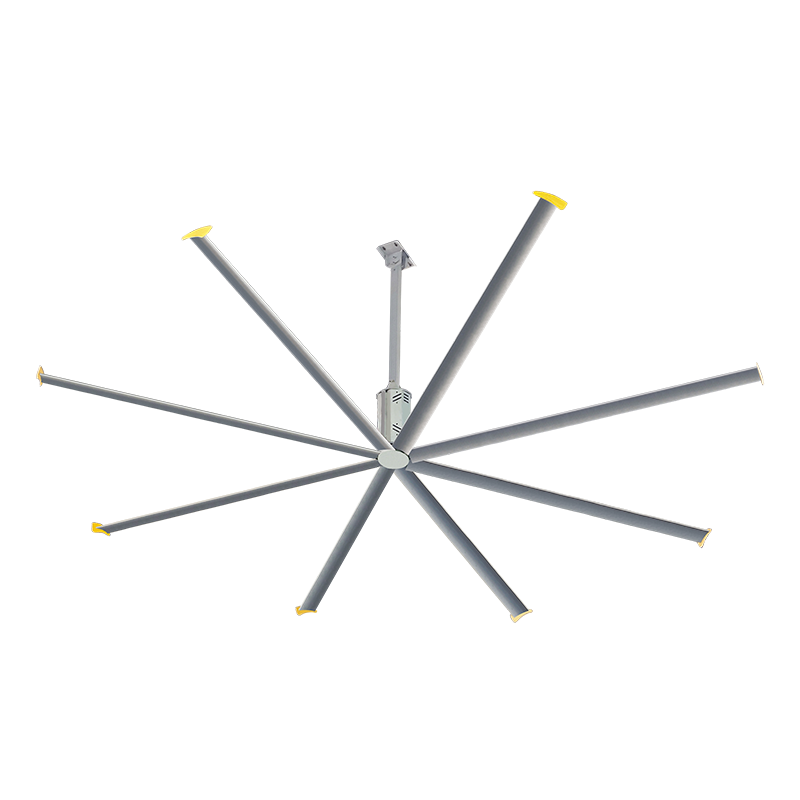
How Industrial Ceiling Fan for Warehouse Ventilation Enhances Airflow and Thermal Comfort
Laminar Flow vs. Turbulent Displacement: Optimizing Air Movement in High-Bay Spaces
Industrial ceiling fans generate laminar flow—a smooth, column-like air stream that moves vertically downward without turbulent mixing. In high-bay warehouses, this directed airflow reaches the floor and spreads radially, displacing warm, stale air toward walls and exhaust points. Unlike turbulent displacement—which relies on chaotic air mixing and often leaves dead zones—laminar flow ensures consistent, uniform air movement across expansive floor areas, eliminating hot spots near machinery or racking. When paired with optimized blade design and pitch angle, these fans deliver 300–500 feet per minute (fpm) at occupant level, lowering perceived temperatures by 5–8°F without added energy use. The vertical air column also inhibits contaminant stratification, guiding particulates toward filtration systems and supporting cleaner breathing air.
Heat Destratification: Eliminating Temperature Layers to Stabilize Warehouse Climate
In warehouses with ceilings over 20 feet, thermal stratification commonly creates temperature differences of 10–15°F between floor and roof. This forces HVAC systems to overwork—increasing energy costs and reducing occupant comfort. High-volume, low-speed (HVLS) ceiling fans counteract this by gently mixing warm ceiling air with cooler air at floor level. This destratification process reduces vertical temperature gradients to within 2–3°F, stabilizing the indoor climate year-round. Facilities report 20–30% reductions in heating energy use after installation, along with reduced condensation on ceilings and walls—lowering mold risk and protecting inventory. When integrated with thermostats or building management systems, fans can activate automatically during peak stratification periods (e.g., early morning in winter or midday in summer), maximizing efficiency without manual intervention.
Reducing Stagnant Zones and Improving Indoor Air Quality Year-Round
Stagnant air pockets—common in warehouse corners, narrow aisles, and near loading docks—trap dust, fumes, VOCs, and airborne particulates, compromising indoor air quality (IAQ). Industrial ceiling fans mitigate this by generating large-scale, continuous airflow that disrupts low-velocity zones and enhances air exchange. Research from the National Bureau of Economic Research links a 10 ppb reduction in indoor pollutants to a 4.2% gain in worker productivity. With strategic fan placement, warehouses achieve near-uniform air distribution, significantly lowering concentrations of respirable particles and volatile organic compounds. This improvement supports employee health—reducing respiratory complaints and absenteeism—while also inhibiting surface mold and mildew growth. Because fans operate efficiently at low speeds and low power, year-round use—paired with routine HVAC filter maintenance—ensures consistently high IAQ, even during off-hours or low-occupancy periods.
Energy Savings and HVAC Integration Benefits of Industrial Ceiling Fan for Warehouse Ventilation
Cutting kWh Consumption: Fans vs. Traditional AC in Large-Space Cooling
Industrial ceiling fans dramatically reduce HVAC energy demand by optimizing air movement—not cooling air itself. In high-bay facilities, each HVLS fan mitigates thermal stratification and enhances evaporative cooling at the skin level, directly decreasing compressor runtime. Compared to HVAC-only operation:
- Traditional AC systems alone consume ~70,000 kWh annually per 10,000 sq. ft., according to U.S. Department of Energy warehouse benchmarks.
- Integrating HVLS fans cuts HVAC cooling loads by 14–34%, delivering measurable savings without sacrificing ASHRAE 55-compliant thermal comfort.
Smart HVAC Synergy: Setpoint Adjustment and Load Sharing Strategies
HVAC integration unlocks deeper savings through intelligent setpoint modulation. Per ASHRAE Standard 55-2021, using ceiling fans permits thermostat adjustments up to +4°F in cooling mode—reducing chiller demand while maintaining occupant comfort. Effective load-sharing strategies include:
- Winter heat recovery: Reverse fan rotation pulls trapped warm air from the ceiling and redistributes it to the occupied zone, cutting boiler runtime.
- Temperature mapping: Data-informed fan placement maintains ±2°F uniformity across the floor plane, eliminating overcooling or overheating in localized zones.
Facilities adopting this coordinated approach report >28% net energy savings—verified in commercial building efficiency studies published by the International Energy Agency (IEA) in 2024.
[^1]: U.S. Department of Energy, Commercial Building Energy Consumption Survey (CBECS) – Warehouse Sector Benchmarks, 2023
[^2]: EPA ENERGY STAR® HVLS Fan Integration Case Studies, 2023
[^4]: International Energy Agency (IEA), Commercial Building Efficiency Reports, 2024
Optimal Selection, Placement, and Dual-Season ROI of Industrial Ceiling Fan for Warehouse Ventilation
Coverage Mapping, Mounting Height, and Clearance Guidelines for Maximum Efficiency
Selecting the right industrial ceiling fan starts with precise coverage mapping: calculate total square footage and measure ceiling height to determine optimal fan diameter and downrod length. Mounting height is critical—too low risks safety and clearance violations; too high diminishes ground-level airflow velocity and efficiency. Maintain minimum clearances of 18 inches from lighting fixtures, 18 inches from sprinkler deflectors (per NFPA 13), and at least 3 feet from top-of-rack storage to ensure unobstructed air delivery and compliance with fire and safety codes. Adhering to these guidelines maximizes airflow performance, minimizes energy waste, and extends equipment service life.
Validating Year-Round ROI: Summer Cooling + Winter Heat Recovery
A well-specified industrial ceiling fan delivers rapid, dual-season return on investment. In summer, the wind-chill effect allows facility managers to raise thermostat setpoints by 4–6°F while maintaining comfort—directly reducing air conditioning runtime and kWh consumption. In winter, reverse-mode operation recaptures heat stratified near the ceiling and gently reintroduces it into the occupied zone, lowering heating demand. This year-round functionality typically yields payback in 12–24 months—making HVLS fans one of the fastest-depreciating, highest-impact energy upgrades available for large industrial spaces.
FAQ: Industrial Ceiling Fan for Warehouse Ventilation
What is laminar flow, and how does it benefit warehouse ventilation?
Laminar flow refers to a smooth, consistent air stream that moves vertically downward without chaotic mixing. Industrial ceiling fans producing laminar flow ensure uniform air distribution, eliminate dead zones, and lower perceived temperatures—enhancing thermal comfort and indoor air quality.
How do industrial ceiling fans contribute to heat destratification?
Industrial ceiling fans mix warm ceiling air with cooler air at ground level, reducing temperature gradients to stabilize warehouse climates. This results in reduced HVAC energy demand and better year-round comfort.
Can industrial ceiling fans improve indoor air quality (IAQ)?
Yes, industrial ceiling fans disrupt stagnant zones and enhance air exchange, reducing concentrations of dust, VOCs, and airborne particulates. This improves employee health and productivity while preventing surface mold and mildew growth.
How much energy can be saved by integrating industrial ceiling fans with HVAC systems?
Facilities can save 14–34% on cooling loads and achieve over 28% net energy savings with coordinated fan and HVAC integration, including thermostat adjustments and load-sharing strategies.
What factors should I consider when selecting an industrial ceiling fan?
Precise coverage mapping, ceiling height, fan diameter, and adherence to clearance guidelines are critical for maximizing efficiency and compliance with safety codes.
Table of Contents
- How Industrial Ceiling Fan for Warehouse Ventilation Enhances Airflow and Thermal Comfort
- Energy Savings and HVAC Integration Benefits of Industrial Ceiling Fan for Warehouse Ventilation
- Optimal Selection, Placement, and Dual-Season ROI of Industrial Ceiling Fan for Warehouse Ventilation
-
FAQ: Industrial Ceiling Fan for Warehouse Ventilation
- What is laminar flow, and how does it benefit warehouse ventilation?
- How do industrial ceiling fans contribute to heat destratification?
- Can industrial ceiling fans improve indoor air quality (IAQ)?
- How much energy can be saved by integrating industrial ceiling fans with HVAC systems?
- What factors should I consider when selecting an industrial ceiling fan?
 ONLINE