 EN
EN
 AR
AR
 BG
BG
 HR
HR
 CS
CS
 NL
NL
 FI
FI
 FR
FR
 DE
DE
 EL
EL
 IT
IT
 KO
KO
 NO
NO
 PL
PL
 PT
PT
 RO
RO
 RU
RU
 ES
ES
 SV
SV
 ID
ID
 LT
LT
 SR
SR
 UK
UK
 VI
VI
 HU
HU
 TH
TH
 TR
TR
 FA
FA
 MS
MS
 HY
HY
 AZ
AZ
 KA
KA
 BN
BN
 LO
LO
 LA
LA
 NE
NE
 MY
MY
 KK
KK
 KY
KY

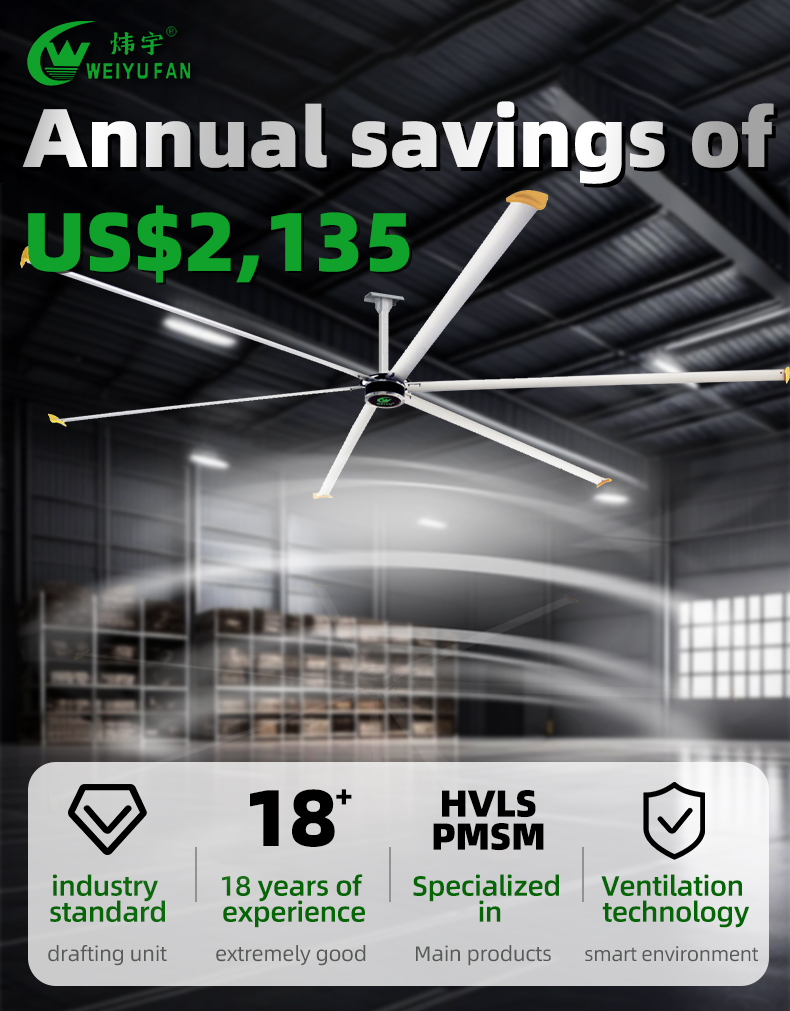
HVLS Fan Energy Savings: Validated 25–30% Reduction in HVAC Load
Field Evidence: Peer-Reviewed Studies and Utility-Verified Results from Industrial Sites
Industrial facilities consistently report 25–30% HVAC energy reductions after installing HVLS fans—data validated across manufacturing plants and distribution centers. Peer-reviewed research confirms these systems cut cooling costs by 20–50% and heating expenses by 20–30% through improved air distribution. Utility-verified case studies show warehouses exceeding 100,000 sq ft eliminated thermal stratification, reducing compressor runtime by 40% in summer and boiler usage by 28% in winter. The underlying mechanism is physiological and physical: high-volume, low-speed airflow creates a wind-chill effect equivalent to a 10°F perceived temperature drop, enabling HVAC setpoints to rise without sacrificing occupant comfort.
Why 30%? The Physics of Low-Speed, High-Volume Air Movement and Thermal Perception
The 30% benchmark reflects thermodynamic principles applied at scale. HVLS fans move massive air volumes at speeds under 5 mph—sufficient to disrupt thermal layers but too gentle to cause drafts. In winter, they recirculate trapped ceiling heat downward; in summer, they enhance evaporative cooling at the skin surface. Critically, human thermal perception adapts to this consistent airflow, allowing ambient temperatures to increase by 4–6°F while maintaining comfort. By eliminating vertical temperature differentials—often exceeding 20°F in high-bay facilities—HVAC systems avoid overcompensating for stratified zones. This destratification-driven load reduction is confirmed by both real-world metering and thermodynamics modeling.
HVLS Fans Eliminate Thermal Stratification — Key to Factory Energy Waste
How Heat Rises: Stratification Dynamics in High-Bay Facilities (>15m Ceilings)
In high-bay industrial spaces with ceilings exceeding 15 meters, warm air accumulates near the roof while cooler air pools at floor level—a natural consequence of buoyancy-driven convection. Temperature differentials between ceiling and occupied zones can reach 31°F (17°C) in unventilated facilities. The higher the ceiling, the more pronounced this layering becomes, wasting energy as heated air stagnates above worker level.
| Stratification Layer | Temperature Variance | Energy Impact |
|---|---|---|
| Ceiling Zone (Top 40%) | +15–20°F (+8–11°C) | Wasted heated air |
| Occupied Zone (0–6 ft) | Target temperature | HVAC overcompensation |
| Floor Zone | -5–10°F (-3–6°C) | Cold spots requiring localized heating |
Destratification in Action: Measured Temperature Equalization & Reduced Heating/Cooling Runtime
HVLS fans reverse stratification by gently mixing ceiling-level air downward in winter and enhancing convective cooling in summer. This achieves uniform temperatures within ±2°F (±1°C) across the occupied zone. Independent studies confirm such destratification reduces annual HVAC runtime by 25–30%. A single 24-foot HVLS fan can effectively serve up to 31,000 sq ft while consuming less power than three conventional floor fans—delivering targeted air movement without turbulence or noise. The result is consistent thermal comfort at worker level and measurable relief for overburdened HVAC equipment.
HVLS Fan Deployment Best Practices for Maximum ROI in Factories and Warehouses
Optimal Sizing, Spacing, and Mounting Height for Uniform Air Coverage
Energy savings and comfort depend on precise deployment. Select fan diameter (8–24 feet) based on bay dimensions—larger spaces benefit from bigger units or strategic clusters. Space fans at 1.5–2 times ceiling height to ensure overlapping coverage and eliminate dead zones. Mounting height is equally critical: position fans 15–30 feet above floor level, adjusting for clearance. For 30-foot ceilings, mounting within 10–15 feet of the roof maximizes disruption of thermal layers—ensuring efficient air exchange across workstations.
Climate & Facility Factors That Influence HVLS Fan Energy Savings (e.g., Insulation, Ceiling Fans vs. HVAC Dependency)
Savings vary with context—but predictable patterns emerge. In humid climates, enhanced evaporative cooling allows thermostat settings to rise 3–5°F while preserving comfort. Insulation quality significantly amplifies returns: facilities with R-30+ insulation retain 40% more conditioned air when paired with HVLS circulation. Northern warehouses realize 20–25% heating cost reductions through heat recirculation alone. Most importantly, integration—not isolation—drives peak performance. When synchronized with building automation systems, HVLS fans reduce HVAC runtime by up to 30% during transitional periods, lowering mechanical stress and extending system lifespan.
Integrating HVLS Fans with Existing HVAC Systems for Synergistic Efficiency
Strategic integration of HVLS fans with conventional HVAC creates a layered climate control strategy that optimizes both comfort and energy use. Rather than replacing HVAC, HVLS fans enhance its effectiveness—distributing conditioned air uniformly, eliminating hot/cold zones, and preventing thermal stratification that forces HVAC units to overcompensate. This synergy enables facilities to raise summer thermostat settings by 2–4°F (or lower them in winter) while sustaining occupant comfort via wind-chill effects—directly reducing HVAC runtime. Field studies verify combined systems lower annual heating and cooling costs by 20–50%, as HVLS fans consume minimal energy while dramatically improving thermal transfer efficiency. Proper implementation requires coordination: place fans to complement—not interfere with—HVAC supply and return paths, ensuring both systems operate in concert. When deployed this way, the integration extends HVAC equipment life and cuts maintenance frequency by reducing mechanical strain.
FAQ
What are HVLS fans? HVLS stands for High-Volume, Low-Speed fans, which are designed to move large volumes of air at low speeds to improve air circulation in large spaces.
How do HVLS fans save energy? HVLS fans help in reducing or eliminating thermal stratification, leading to reduced HVAC load, thereby saving energy on heating and cooling.
Can HVLS fans be used in all climates? Yes, HVLS fans can be effective in various climates. They enhance evaporative cooling in humid climates and assist heat recirculation in cooler environments.
Do HVLS fans replace HVAC systems? No, HVLS fans are designed to work alongside HVAC systems, enhancing their efficiency and reducing their load.
What is the recommended mounting height for HVLS fans? HVLS fans should be mounted 15–30 feet above the floor, adjusting for ceiling height to maximize air coverage and ensure optimal functionality.
 ONLINE